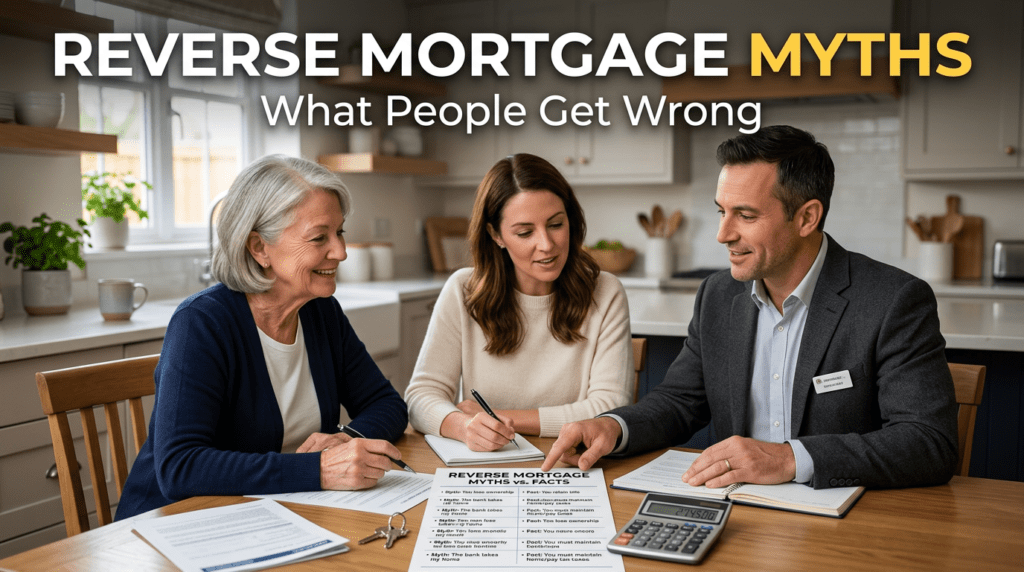
Reverse mortgages are often misunderstood because people focus on myths instead of the actual loan rules. A HECM reverse mortgage does not mean the bank owns the home, does not eliminate homeowner responsibilities, and does not automatically leave heirs with personal debt. The borrower keeps title, but must follow loan obligations, and the loan is usually repaid when the borrower sells, moves out, or passes away.
What Is a Reverse Mortgage?
A reverse mortgage is a loan that allows eligible homeowners to access part of their home equity while continuing to live in the home.
The most common type is the Home Equity Conversion Mortgage, or HECM. The CFPB describes a HECM as a special home loan only for homeowners who are 62 or older, and HUD identifies HECM as FHA’s reverse mortgage program.
Unlike a traditional mortgage, a HECM does not require monthly principal and interest payments. Instead, the loan is typically repaid later, often when the borrower sells the home, permanently moves out, or passes away.
That sounds simple, but the misunderstanding starts when people hear “no monthly mortgage payment” and assume “no responsibilities.”
That is false.
Why Reverse Mortgages Are Often Misunderstood
Reverse mortgages are misunderstood because they reverse the normal mortgage pattern.
With a traditional mortgage:
- You borrow money
- You make monthly payments
- Your loan balance usually decreases
With a reverse mortgage:
- You access home equity
- You usually do not make required monthly principal and interest payments
- The loan balance generally grows over time
That structure feels unfamiliar, so people fill the gaps with fear, rumors, and assumptions.
The result: seniors avoid a tool that might help them, or they use it without fully understanding the obligations.
Both are bad outcomes.
Misunderstanding #1: “The Bank Owns Your Home”
This is the biggest myth.
The CFPB is clear: when a borrower takes out a reverse mortgage, the title to the home remains with the borrower.
That means:
- The borrower remains the homeowner
- The borrower keeps title
- The lender does not automatically own the property
- The home still belongs to the borrower, subject to the mortgage lien
The lender has a lien, not ownership.
That distinction matters.
A mortgage lien gives the lender a secured interest in the property. It does not mean the lender owns the house while the borrower is living there and meeting loan obligations.
Misunderstanding #2: “You Never Have to Pay Anything Again”
This is another dangerous myth.
A reverse mortgage removes required monthly principal and interest payments, but it does not remove all homeowner obligations.
The CFPB states that HECM borrowers have three main responsibilities: occupy the home as a principal residence, pay property charges such as taxes and insurance, and keep the home in good repair. If borrowers do not meet these requirements, they could lose the home to foreclosure.
Borrowers must still:
- Pay property taxes
- Keep homeowners insurance current
- Maintain the property
- Live in the home as the primary residence
- Follow the loan terms
This is where many bad reverse mortgage stories come from.
The loan itself did not “take the home.” The borrower failed to meet required obligations.
That distinction is brutal but important.
Misunderstanding #3: “Reverse Mortgages Are Free Money”
A reverse mortgage is not free money.
It is a loan.
The borrower is accessing home equity, and the loan balance must eventually be repaid.
This misunderstanding often comes from poor advertising. Some ads make reverse mortgages sound like a government benefit or retirement bonus. That is misleading.
A HECM may be FHA-insured, but that does not make it a grant. HUD describes the HECM as FHA’s reverse mortgage program that allows homeowners to withdraw a portion of home equity.
The better explanation is:
A reverse mortgage converts home equity into accessible loan proceeds.
That is useful.
But it is not free.
Misunderstanding #4: “Heirs Will Be Stuck With the Debt”
This fear stops many families from even considering a reverse mortgage.
For FHA-insured HECMs, heirs are generally protected by non-recourse rules. The CFPB explains that if the loan balance grows larger than the value of the home, the borrower or heirs may not have to pay the difference, and mortgage insurance may cover the remaining balance if the home sells for appraised fair market value.
This means heirs do not usually inherit personal liability for the reverse mortgage debt.
However, heirs still must deal with the property.
They may need to:
- Sell the home
- Refinance
- Pay off the loan
- Work with the servicer
- Handle estate or probate issues
So the myth is wrong, but the responsibility is real.
Heirs may not inherit personal debt, but they do inherit a decision.
Misunderstanding #5: “Heirs Automatically Lose the Home”
Heirs do not automatically lose the home.
The CFPB explains that after the borrower dies, heirs may be able to keep or sell the home depending on whether there are co-borrowers or eligible non-borrowing spouses. If there are neither, heirs who want to keep the home must usually pay the full loan balance or 95% of the appraised value if the loan balance is more than the home value.
This is commonly called the 95% rule.
It matters because it can help heirs keep the home even when the reverse mortgage balance is higher than the home’s current value.
But heirs must act.
Delay, poor communication, probate issues, and family disagreements can still create problems.
Misunderstanding #6: “You Can Move Out and Keep the Reverse Mortgage Forever”
A reverse mortgage is tied to the home being the borrower’s primary residence.
If the borrower permanently moves out, the loan may become due and payable.
The CFPB explains that reverse mortgage loans typically must be repaid when the borrower moves out or dies, though certain protections may apply if a co-borrower or eligible non-borrowing spouse remains in the home.
This is especially important for seniors who may need:
- Assisted living
- Nursing home care
- Long-term medical care
- Extended stays with family
Families should discuss this before a crisis happens.
A reverse mortgage can support aging in place, but it is not a long-term care plan by itself.
Misunderstanding #7: “Anyone Living in the Home Is Automatically Protected”
Having a reverse mortgage does not automatically protect everyone who lives in the home.
The CFPB states that a reverse mortgage does not change who can live with the borrower, but if the borrower dies or moves out, the loan becomes due. Family members or heirs may need to pay off the reverse mortgage to stay in the home.
This is where families get surprised.
An adult child, sibling, caregiver, or relative may live in the property, but that does not automatically mean they can stay after the borrower permanently leaves or passes away.
The protection depends on loan terms, borrower status, spouse status, and applicable HECM rules.
This is why household planning matters.
Misunderstanding #8: “Counseling Is Just a Formality”
HECM counseling is not supposed to be a box-checking exercise.
HUD provides a HECM counselor search tool, and HUD Exchange identifies HECM counseling as part of the reverse mortgage process.
The purpose is to help borrowers understand:
- Costs
- Alternatives
- Obligations
- Repayment triggers
- Impact on heirs
- Long-term responsibilities
If a senior leaves counseling still confused, the process has failed.
A reverse mortgage is too serious to treat counseling like paperwork.
The Real Reason Reverse Mortgages Get a Bad Reputation
Reverse mortgages get a bad reputation for three main reasons:
- Bad explanations
- Bad fit
- Bad planning
A reverse mortgage can be legitimate and still be wrong for a specific borrower.
It may be a poor fit if the borrower:
- Plans to move soon
- Cannot maintain the home
- Cannot pay taxes and insurance
- Wants to preserve maximum equity for heirs
- Does not understand how the balance grows
- Is being pressured by family, contractors, or salespeople
The loan is not automatically bad.
But using it without a strategy is.
When a Reverse Mortgage May Make Sense
A reverse mortgage may make sense for a senior who:
- Is 62 or older
- Has meaningful home equity
- Wants to remain in the home
- Needs better retirement cash flow
- Understands the obligations
- Can pay taxes, insurance, and maintenance
- Has discussed the decision with family or advisors
- Has completed proper counseling
The best borrower is not the one asking, “How much can I get?”
The best borrower asks:
“How does this fit my retirement, housing, healthcare, and estate plan?”
When a Reverse Mortgage May Not Make Sense
A reverse mortgage may be the wrong move if:
- The borrower plans to sell soon
- The home is too expensive to maintain
- Property taxes or insurance are already difficult to pay
- Family members depend on staying in the home after the borrower leaves
- The borrower wants to preserve as much home equity as possible
- The borrower does not understand the loan terms
- Someone is pressuring the borrower to sign
A reverse mortgage should create more stability, not more risk.
Reverse Mortgage Misunderstanding Checklist
Before judging or using a reverse mortgage, ask:
- Do I understand who owns the home?
- Do I understand when the loan is repaid?
- Do I understand how the balance grows?
- Do I understand taxes and insurance obligations?
- Do I understand what heirs must do later?
- Do I understand non-recourse protection?
- Do I understand the 95% rule?
- Do I understand what happens if I move out?
- Do family members understand the plan?
- Have I completed legitimate HECM counseling?
If the answer is no, the problem is not just the mortgage.
The problem is lack of education.
Frequently Asked Questions
Why are reverse mortgages misunderstood?
Reverse mortgages are misunderstood because they work differently from traditional mortgages. Borrowers usually do not make required monthly principal and interest payments, but the loan balance grows over time and must eventually be repaid. Confusion often comes from myths about ownership, heirs, taxes, insurance, and repayment.
Does the bank own your home with a reverse mortgage?
No. The CFPB states that when a borrower takes out a reverse mortgage, title remains with the borrower. The lender has a lien, but the borrower remains the homeowner.
Can you lose your home with a reverse mortgage?
Yes. A reverse mortgage borrower can lose the home if they fail to meet requirements such as living in the home as a principal residence, paying property taxes and insurance, and keeping the home in good repair.
Do heirs inherit reverse mortgage debt?
For FHA-insured HECMs, heirs generally do not inherit personal liability beyond the home’s value. If the loan balance exceeds the home value, mortgage insurance may cover the shortfall when the home sells for appraised fair market value.
Can heirs keep a home with a reverse mortgage?
Yes, in many cases. Heirs may keep or sell the home, but they must resolve the reverse mortgage. If the loan balance is more than the home value, heirs may be able to satisfy the loan by paying 95% of the appraised value.
Reverse mortgages are misunderstood because people want simple answers to a complex product.
They ask:
“Is it good or bad?”
That is the wrong question.
The better question is:
“Does this specific reverse mortgage fit this specific borrower’s home, cash flow, family, health, and estate plan?”
A reverse mortgage can protect retirement cash flow for one senior and create problems for another.
The difference is not the product alone.
The difference is planning.
Before dismissing or choosing a reverse mortgage, get the facts. A proper review should explain ownership, repayment, heirs, taxes, insurance, maintenance, and long-term fit before any decision is made.
EstaR Mortgage | NMLS#1547521
510-463-1003
MyLender@estarm.com
